Last Updated on July 19, 2026 by Patrick Camuso, CPA
Kalshi is no longer an experimental corner of the internet. It describes itself as the first CFTC-regulated event-contract exchange operating in the United States, and it now sits at the intersection of trading, macro forecasting, and real capital deployment.
Because Kalshi operates within a formal regulatory framework and because some traders receive tax forms, many assume Kalshi tax reporting is straightforward. It is not.
While Kalshi differs meaningfully from offshore or decentralized prediction markets, its tax reporting still leaves critical analytical gaps. The forms a trader receives do not determine tax character, do not capture full contract-level activity, and do not resolve the unsettled questions surrounding how event-based contracts should be treated under existing U.S. tax law.
This article is Kalshi-specific. It explains:
- What Kalshi actually reports (and what it does not)
- Why tax forms are a starting point, not a conclusion
- How Kalshi event contracts are analyzed under existing law
- Why Section 1256 is often raised and why it remains unsettled
- What defensible reporting looks like in practice
For a broader discussion of prediction markets generally, including capital vs. ordinary treatment debates and why USD settlement does not simplify tax analysis, see our full prediction market tax analysis.
What Makes Kalshi Structurally Different
Kalshi operates as a CFTC-regulated Designated Contract Market (DCM). That regulatory status distinguishes it from:
- On-chain prediction markets
- Offshore event-contract platforms
- Traditional sports betting operators
From a regulatory standpoint, Kalshi contracts are standardized, centrally cleared, and traded on a U.S.-regulated exchange. From a tax standpoint, it matters, but it does not answer the question. CFTC regulation affects market structure, not automatic tax classification. As we explain in our main analysis, regulatory status introduces analytical considerations but does not provide definitive answers.
What Kalshi Actually Reports (and What It Doesn’t)
One of the most common misconceptions among Kalshi traders is that Kalshi provides complete broker-style tax reporting. It does not.
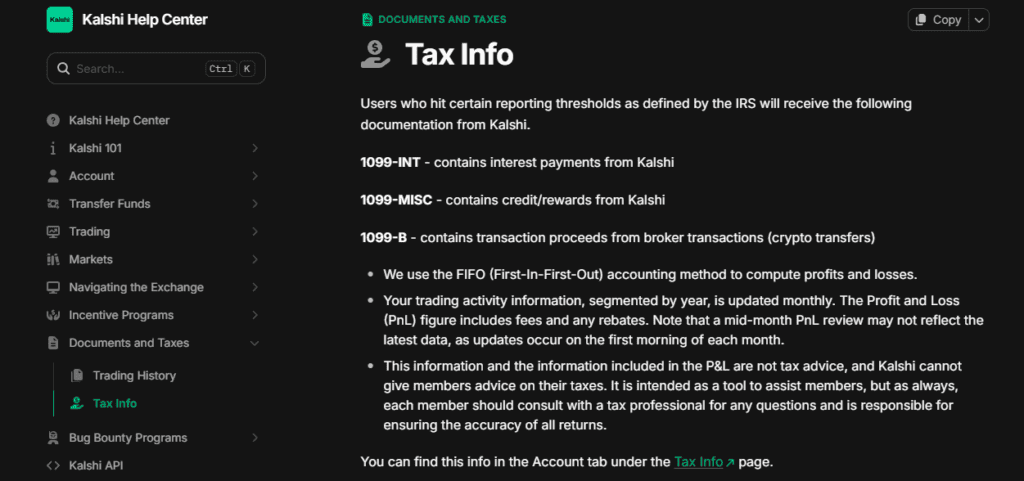
Forms Kalshi May Issue (Limited and Incomplete)
Based on Kalshi’s public disclosures:
- Form 1099-MISC :May be issued for certain credits or rewards (such as referral bonuses) if they total $600 or more.
- Form 1099-INT: May be issued for interest earned on cash balances if it totals $10 or more.
- Form 1099-B: Currently used only for limited broker-type transactions, not for standard event-contract trading activity.
- Form 1099-DA: Not mentioned by Kalshi. May be issued for digital asset transactions processed through Kalshi’s third-party digital asset provider.
Kalshi does not currently issue comprehensive 1099-B reporting covering contract-level acquisitions, dispositions, basis, or total annual profit and loss from event contracts. Kalshi provides a PnL statement summarizing trading activity, including profits, losses, and fees. That statement and any listed information returns do not determine federal tax character or necessarily contain every record required to support the return.
What This Means for Traders
- The IRS may see some Kalshi-related income
- The IRS does not receive a full contract-level trading picture
- Absence of a comprehensive 1099 does not eliminate reporting obligations
Why Kalshi Tax Treatment Remains Unsettled
Despite Kalshi’s regulated status and the presence of limited tax forms, U.S. tax law does not provide clear guidance on how event-based prediction contracts should be characterized for federal income tax purposes. The Internal Revenue Code was not drafted with event-based markets in mind. As a result, Kalshi contracts do not map cleanly onto existing categories such as securities, commodities futures, options, or wagering transactions.
This lack of statutory fit creates genuine analytical uncertainty:
- There is no IRS guidance addressing prediction market contracts directly
- Event-based contracts settle on binary outcomes rather than prices, rates, or indices
- Information reporting, where it exists, is incomplete and does not resolve character
- Multiple Code sections may plausibly apply depending on interpretation and facts
In the absence of specific guidance, tax treatment must be determined by applying general tax principles to novel fact patterns. Reasonable professionals can and do disagree on the correct framework. That disagreement does not mean reporting is optional. It means that consistency, documentation, and risk awareness matter more than optimization.
How Kalshi Event Contracts Are Analyzed Under Existing Law
Step One: Realization Under Section 1001
Kalshi trading generally involves:
- Acquiring a transferable contractual right
- Paying consideration to acquire that right
- Selling that right to another participant before resolution, or holding it to resolution
- Receiving amounts determined by the sale price or the contract’s resolution
An actual pre-resolution transfer of the contract right to another participant for consideration may be described as a sale and analyzed under Section 1001. The treatment of a position held to resolution, including resolution at zero, depends on the contract terms and platform mechanics and should not be generically classified.
Step Two: Character Analysis Comes After
For an actual pre-resolution sale, Section 1001 may govern gain-or-loss measurement. Character and the possible application of another statutory regime, including the wagering rules or Section 1256, must then be analyzed separately. Treatment of a position held to resolution remains dependent on the contract terms and platform mechanics.
Kalshi Tax Reporting Frameworks Observed in Practice
In unsettled areas of tax law, the goal is not to find the most favorable outcome, but the most defensible one. Positions should be reasonable, consistently applied, and supported by records that would withstand examination years later.
Ordinary-Income Reporting
Under this approach, Kalshi activity is reported as ordinary income, often mirroring limited 1099 reporting.
Pros
- Simple
- Aligns with the limited forms issued
Cons
- Potential overpayment
- Minimal analytical documentation
- Loss deductibility is not automatic
Ordinary character alone does not establish recognition, deductibility, placement, limitation, or netting. For an individual, an otherwise allowable ordinary nonbusiness loss outside a sale or exchange is a miscellaneous itemized deduction currently disallowed under Section 67(h). For the full loss analysis, see our prediction market loss deductions article.
Capital Gain/Loss Reporting
Under this framework, Kalshi contracts are analyzed as transferable contractual rights under Section 1001, with character considered under Section 1221. Whether contracts qualify as capital assets is fact-dependent and subject to interpretation.
Pros
- Standard capital framework
- Full loss netting
Cons
- Requires reconstruction
- Mostly short-term treatment in practice
Section 1256 Treatment
Section 1256 is frequently raised in discussions of Kalshi taxation because the exchange is CFTC-regulated. However, §1256 treatment for event-based prediction contracts is unsettled and should not be viewed as a default or generally advisable position. Section 1256 is not a taxpayer election, and venue qualification alone does not establish that a contract is a Section 1256 contract. For the full analysis, see our dedicated article, Section 1256 and Prediction Markets.
The Dollar Impact of §1256 Treatment
For a Kalshi trader with substantial winnings, the difference between frameworks is material.
Example: $100,000 in net Kalshi gains, high-income taxpayer (37% bracket)
| Treatment | Federal Tax Liability |
|---|---|
| Ordinary income | ~$37,000 |
| §1256 (60/40 split)* | ~$26,800 |
*Assumes 60% taxed at 20% LTCG, 40% at 37% ordinary.
The tax benefit is real. The analytical burden is also real. This example illustrates why §1256 is often discussed, not why it should be adopted. Tax benefit alone does not determine defensibility.
What §1256 Reporting Actually Looks Like
The following describes reporting mechanics only and should not be read as an endorsement of §1256 treatment.
If a taxpayer determines §1256 applies:
-
Form 6781
-
Mark-to-market year-end positions
-
Report realized + unrealized gains/losses
-
-
Schedule D
-
Apply 60/40 split
-
Compared to ordinary income (Schedule 1) or standard capital gains (Form 8949), §1256 is significantly more complex.
Reconstruction and Reporting Mechanics
Regardless of whether Kalshi activity is reported as ordinary income, capital gain or loss, or under a specialized statutory regime, accurate reporting requires reliable reconstruction of trading activity.
Information returns, where issued, do not provide a complete transaction-level record of event-contract trading. Platform summaries may not contain every detail needed to support the reporting method used.
In practice, defensible reporting requires:
- Downloading full transaction history from the platform
- Identifying each contract acquisition and disposition or settlement
- Reconciling reported amounts to platform records and cash flows
- Applying the chosen reporting framework consistently
- Retaining supporting documentation
Ordinary-income reporting may reduce interpretive complexity around character, but it does not eliminate the need to substantiate amounts, timing, or net results. Reconstruction is a compliance requirement, not an elective optimization step.
This is analytical work, not data entry. Verify the units and sign conventions used in the export before building any summary, and cross-check a single transaction manually against your account history. Export formats change, and a units error can overstate or understate results by orders of magnitude. For traders with significant Kalshi activity, professional guidance on framework selection, reconstruction, and documentation is often warranted.
Common Kalshi Reporting Errors
- Assuming the tax form dictates treatment or reporting
- Claiming §1256 without documentation
- Mixing reporting frameworks
- Ignoring year-end positions
- Relying solely on dashboards
- Reporting contracts as gambling income
When Specialized Analysis Makes Sense
DIY reporting may be sufficient if:
- Dollar amounts are modest
- Ordinary-income treatment is acceptable
- Risk tolerance is low
Specialized analysis is often warranted when:
- Net profits, gains or losses are substantial
- §1256 or capital treatment is considered
- Audit defensibility matters
- Activity spans multiple tax years
At Camuso CPA , we work with Kalshi traders to evaluate whether any alternative framework is supportable, reconstruct contract lifecycles, and prepare tax returns as appropriate. This is interpretive work in an unsettled area of tax law.
Press Coverage
Patrick Camuso, CPA has been quoted on prediction market taxation across major financial publications:
Press Coverage
Patrick Camuso, CPA has been quoted on prediction market taxation across major financial publications:
Watch: Kalshi Taxes: Why Your 1099 Is Incomplete
Kalshi Tax Reporting FAQ
Do you have to pay taxes on Kalshi?
Yes. Profits from Kalshi event contracts are taxable regardless of whether Kalshi issues a tax form. Characterization remains unsettled, and ordinary, capital, and Section 1256 frameworks are all discussed; whatever framework is used must be supportable and consistently applied. The absence of a 1099 covering trading activity does not reduce the reporting obligation.
Does Kalshi report to the IRS?
Kalshi reports limited information to the IRS. It may file Form 1099-MISC for certain credits or rewards and Form 1099-INT for interest on cash balances. Limited Form 1099-B or Form 1099-DA reporting may also apply to digital asset transactions. It does not currently file comprehensive broker-style reporting covering contract-level trading gains and losses. The IRS may see some Kalshi-related income without receiving a full picture of trading activity, and traders remain responsible for reporting all taxable results.
How are Kalshi winnings taxed?
Kalshi winnings are taxable income, but the IRS has not issued guidance specific to event contracts, so the exact characterization remains unsettled. Ordinary, capital, and Section 1256 frameworks are each discussed, and each carries different documentation and audit considerations. Whatever framework is used must be applied consistently and supported by complete transaction records.
Does Kalshi issue comprehensive tax forms like a brokerage?
Not comprehensively. Kalshi may issue Form 1099-MISC for certain credits or rewards (such as referral bonuses), Form 1099-INT for interest on cash balances, and limited Form 1099-B or Form 1099-DA reporting tied to digital asset transactions, and it provides a PnL statement summarizing trading activity, including profits, losses, and fees. That statement and any listed information returns do not determine federal tax character or necessarily contain every record required to support the return. As a result, traders are responsible for substantiating contract-level gains and losses regardless of whether any tax form is received.
How should Kalshi trading activity generally be reported for U.S. tax purposes?
Because the IRS has not issued prediction-market-specific guidance, traders must apply existing tax principles. No single approach is established. The characterization frameworks discussed include ordinary, capital, and Section 1256 treatment, and the loss rules differ materially among them. Whatever framework is used should prioritize consistency, documentation, and audit defensibility in the absence of clear statutory direction, and ordinary character alone does not establish how losses are deducted.
Can Kalshi contracts qualify for Section 1256 treatment?
Section 1256 treatment is unsettled for event-based prediction contracts and should not be viewed as a default or generally advisable position. While Kalshi’s CFTC regulation is relevant to the venue element of §1256, event-based contracts that settle on binary outcomes do not clearly fit within the statute’s traditional scope. Claiming §1256 treatment would require strong factual support, formal analysis, Form 6781 reporting, and a willingness to defend the position under examination.
If no tax form is issued, is reporting still required?
Yes. The absence of a 1099 does not eliminate the obligation to report taxable activity. Traders should maintain complete platform transaction histories, settlement records, account statements, and valuation data. These records should be retained for the applicable limitations period and for as long as they remain relevant to an open tax year or carryover, and must support whatever reporting framework is used.
Are prediction market profits treated as gambling winnings?
Not automatically. No published guidance establishes a universal federal tax classification for prediction-market contracts. The answer depends on the contract terms and relevant facts. Ordinary-income treatment does not imply gambling treatment, and wagering loss limitations do not automatically apply. See our analysis of whether prediction market profits are gambling income.

This article is provided by Camuso CPA for general informational purposes and does not constitute legal, tax, accounting, or investment advice. Tax laws and regulations are evolving rapidly and the information presented may not reflect current guidance. Reading this article does not create a CPA-client relationship. For advice on your specific situation, schedule a consultation with Camuso CPA.
Camuso CPA, PLLC